


Virtual Tour
We welcome you to explore Michigan's only National Historic Landmark Pottery through this virtual self-guided tour. Although our pottery is best experienced in person, this virtual tour experience will give you a visual overview of the people and processes that have kept Pewabic running for over 120 years. Scroll down to begin.
ONSITE self-guided tours - Fridays from 11:00 am - 4:00 pm
Onsite self-guided tours of the fabrication area are open on Fridays between 11:00 AM & 4:00 PM. Please check the sign outside fabrication area to confirm it is open. You can start your onsite tour at the link below.
our history
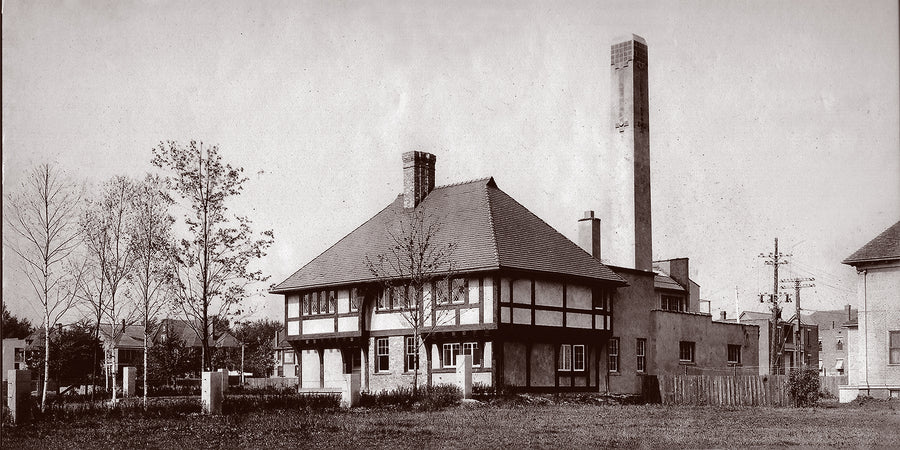
Founded in 1903 by Mary Chase Perry Stratton and Horace Caulkins, Pewabic has been a cornerstone of handcrafted tile and vessel production in Detroit for over a century.

1. the kiln room
Step into the Kiln Room, a space that has remained remarkably unchanged since its construction in 1907. This room houses three large, natural gas-firing kilns, which process all of the pottery and tiles made by Pewabic. Every piece crafted here undergoes at least two firings. The initial bisque firing reaches 1945 degrees F, hardening the dry clay into a pourous ceramic. After glaze is applied, the pieces are fired again at 2300 degrees F, melting the glaze and vitrifying the clay. The only exception is our iridescent wares, as these special pieces require a uniquely formulated glaze and third specialty firing where a liquid mixture is injected into the kiln to achieve their distinctive metallic surfaces.

2. clay making
Our tour continues on to the Clay Mixer, an incredible system that has been in continuous use by Pewabic since 1912. To create the clay body, our staff first mixes dry clay ingredients with water in the large tank called the Blunger Mill, forming a liquid clay known as "slip." This slip then drains into the underground Agitator Tank to age, a crucial step that ultimately makes the clay more flexible and workable. Finally, the liquid clay slip is pumped through the Filter Press; which drives out excess water. These steps, repeated by Pewabic staff for over a century, result in a soft, pliable clay, perfectly suited for pressing into tiles.

3. glazing
Next, we enter the Glazing Area, where all of the pottery and tiles created by Pewabic receive their unique finish. All of Pewabic's glazes are formulated in-house, a process that requires a deep knowledge of both art and chemistry. We continually reformulate our glazes to meet today's health and safety standards, as we no longer use original recipes. Glazes are applied by dipping, pouring, spraying, or hand-painting, and then sent back to the Kiln Room for their second firing.

Glaze Spray Booth
Although we use a few techniques to glaze our ceramics, like dipping and hand-painting, most Pewabic work is glazed in our Spray Booth.
Our in-house formulated glazes are poured into the tank of the spray gun and both tiles and vessels are sprayed in this booth. Three layers of glaze to ensure consistency before going back into the kiln for their next firing.

4. mold making & tile pressing studio
The Maxine and Stuart Frankel Pewabic Tile Studio was added in 2018. Despite being the newest expansion at Pewabic, it houses processes that have remained largely unchanged since our founders' time. Here, tiles are formed in a variety of ways, much as they were historically: some are pressed using either an arbor or ram press, others are cut, and some are extruded. To ensure consistency and efficiency, tile molds are essential, allowing our staff to produce many tiles of the same design simultaneously. These molds, crafted from plaster, are all created right here on-site by our dedicated Master Mold Maker, continuing a tradition of meticulous craftsmanship at Pewabic.

5. education studio
On the second floor you'll discover the Education Studio, a vibrant studio that hosts a variety of engaging programs, from hands-on tile glazing workshops to multi-week classes. Please be mindful of student work and studio equipment while in this space. If a class is actively in session, the studio may be inaccessible to ensure a focused learning environment. Education has always been a cornerstone of Pewabic's mission, with classes operating here since its earliest years, continuing a rich legacy of artistic instruction. Explore the full range of Pewabic's offerings here.
Thank you
Access to our virtual tour is free thanks to the generous operating support provided by our members, donors, the Michigan Arts & Culture Council, and the National Endowment for the Arts. Learn more about how you can support Detroit's Pewabic Pottery today.
Notes about friday self-guided tours:
SELF-GUIDED TOUR TIMES: Fridays from 11:00 AM - 4:00 PM
If you are visiting during open touring hours, simply follow the number key on your map to navigate your tour. Each numbered stop corresponds to a brief summary of the space you're observing along the path, along with a short video showing the processes used in that space.
YOU ARE ENTERING AN ACTIVE WORK SPACE. PLEASE FOLLOW THESE SAFETY GUIDLINES:
1. Stay within the yellow striped tour path and watch your step.
2. Do not touch any equipment or objects along the path.
3. Remain aware of your surroundings as this is an active work space.
Please note: As your explore, you'll see our talented staff at work. Please be mindful that they need to remain focused on their tasks and aware of their surroundings, and may not be able to stop and answer questions. We appreciate your understanding and hope you enjoy your visit to Pewabic Pottery!